
What Are the Key Differences Between Bing and Google SEO?
Bing and Google are two of the most recognizable search engines in the world. While Google generally steals the limelight in terms of sheer numbers, Bing is a viable alternative and one of the few choices people have besides Google.
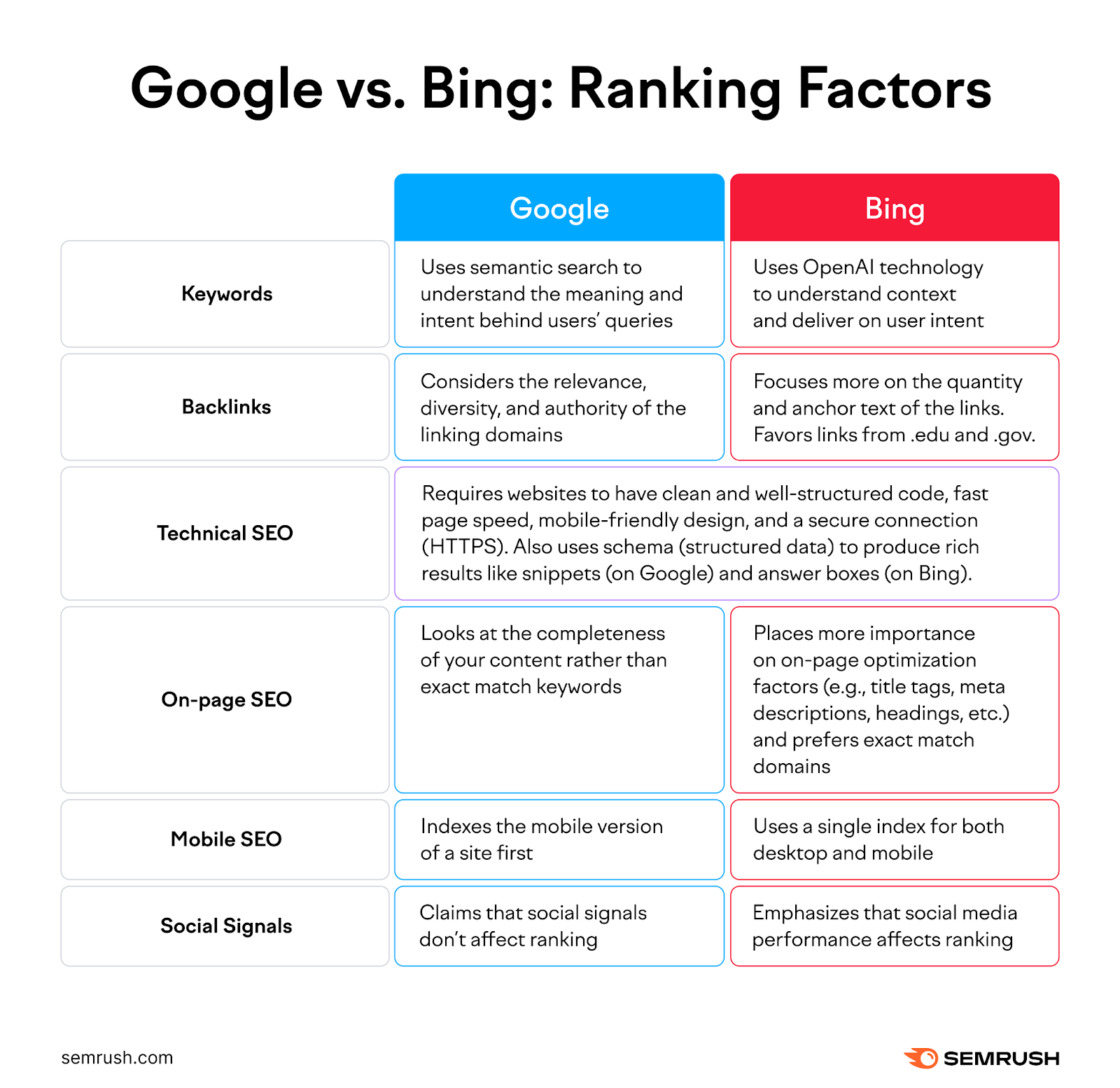
Just like Google, Bing has its own SEO. Since most of the digital marketing narrative is centered around optimizing presence on Google, Bing is not talked about as often. Like Google, Bing SEO also exists to make sure the most relevant search results are ranked first. However, Google and Bing use different algorithms when ranking content.
Since Google hogs most of the limelight, many SEOs do not know how Bing SEO actually works. This leads to a situation where most marketers in the industry have little to no idea regarding Bing SEO. In the short term, it might seem pointless to learn Bing SEO. However, every inch of marketing space can be crucial in the long run. Even a top ranking on Bing can bring in sizable traffic.
Only the top digital marketing institutes are conscientious enough to teach Bing SEO to their students. It is not a topic on which one can find a lot of expertise or attention. Students must make it a priority to know the key differences between Bing and Google SEO.
In this article, we highlight some key differences between Google and Bing SEO.
Backlinks: Bing SEO vs Google SEO
In the early days, Google laid a lot of emphasis on the number of backlinks coming to a given webpage. That is not the case anymore. Google values the quality and authority of backlinks a website has more than the quantity. The more relevant backlinks a website has, the better its ranking will be. Building unworthy and spammy backlinks can, in fact, lead to a decline in rankings on Google.
On Bing, things are more old-fashioned. The quantity of backlinks is an important metric. This leads to websites with a higher number of backlinks being ranked better. Backlinks from websites with .edu, .gov, and .org extensions tend to be considered of great quality by Bing. Overall, techniques that help acquire more backlinks are beneficial for Bing SEO.
Case Study
A niche educational website focused on quantity-based link building through directory listings and academic references. While results on Google remained limited, the site achieved first-page visibility on Bing within weeks due to a higher backlink volume.
Keywords: How Bing and Google Handle Keyword Optimization
While Google has evolved in keyword analysis by understanding the context and intent of the user, Bing still values exact-match keywords. In other words, if you wish to rank content on Bing, using an exact key phrase is the best approach. Unlike Google, Bing is less effective at gauging user intent and relies more on content containing a higher frequency of the exact keyword searched.
Note:
Keyword stuffing should still be avoided, as readability and relevance remain important even when optimizing for exact-match keywords on Bing.
Social Media Preference in Bing and Google SEO
Generally, Google does not necessarily consider social media popularity a direct ranking factor. If a blog post has been shared ten times on Twitter and another has been shared a hundred times, Google evaluates them using the same core SEO guidelines.
Bing, on the other hand, values social signals significantly. The more shares a piece of content receives, the more likely it is to perform well on Bing SERPs. While ranking content for Bing, marketers should strengthen their SMO strategy alongside traditional SEO efforts.
Case Study
A lifestyle blog actively promoted its articles on social media platforms. Despite minimal backlink growth, the blog experienced noticeable ranking improvements on Bing due to high engagement and frequent social shares.
Note:
A combined SEO and social media strategy can deliver better results on Bing compared to relying on SEO techniques alone.
In Conclusion: Understanding Google vs Bing SEO Differences
In conclusion, this article covers three key differences between Google and Bing SEO. While Google prioritizes intent, quality backlinks, and advanced algorithms, Bing rewards exact keywords, backlink quantity, and social engagement. Understanding both platforms allows marketers to tap into additional traffic opportunities often overlooked.
Related Posts:


IIFRA is a leading skill-development institute in India, specializing in Digital Marketing, Cyber Security, Ethical Hacking, Business Analytics, and other future-ready programs. With a strong focus on practical training, industry-aligned curriculum, and career-oriented learning, IIFRA empowers students and professionals to build successful careers in the digital and technology-driven world.