
Google Company Overview: History, Market Value, and Search Engine Dominance
Google has become, in recent years, one of the most expensive stock indexes, often reaching the threshold of 620 points. It has become an indispensable tool for surfing the internet for more than 91% of the American population. The search engine was founded in January 1996 by Sergey Brin and Larry Page. Larry Page created PageRank, an algorithm for ranking pages. The PageRank equation has not yet been unveiled, but by studying the results presented in the famous search engine, we can learn that it is based on two main criteria:
- The number of incoming and outgoing links on a page.
- The number of pages of a site.
Google Advertising Model and Revenue Generation
Advertising
Advertising is the largest source of revenue for Google (more than 95% of revenue generated by Google). $23 trillion was earned by the search engine in 2010 through AdWords, which is an advertising platform created in October 2000. It covers more than 87% of the advertisements posted on the web.
The three largest customers of Google AdWords:
- AT&T Mobility or AMP (8.08 million).
- Apollo Group (6.67 million).
- Expedia (5.95 million).
Google Executive Leadership and Management Team
Executive Officers
- Larry Page
- Eric E. Schmidt
- Sergey Brin
- Nikesh Arora
- David C. Drummond
- Patrick Pichette
Origin and Meaning of the Name Google
The Origins of the Name
The company name “Google” has its origin in the mathematical term “googol,” which refers to 10¹⁰⁰, that is to say, a number starting with 1 followed by one hundred zeros. Larry Page and Sergey Brin asked other computer science students in 1997 to help name the fruits of their labor.
The idea reportedly came from Sean Anderson, who suggested “googolplex,” a name that attracted Larry Page. He asked him to go and register the domain name “googol.” Sean Anderson reportedly made a mistake while entering the name and typed google.com. Others say that the domain name was not available as it was already assigned and that, therefore, the name was changed voluntarily.
Google Logo Evolution and Google Doodles
The Logo of the Firm
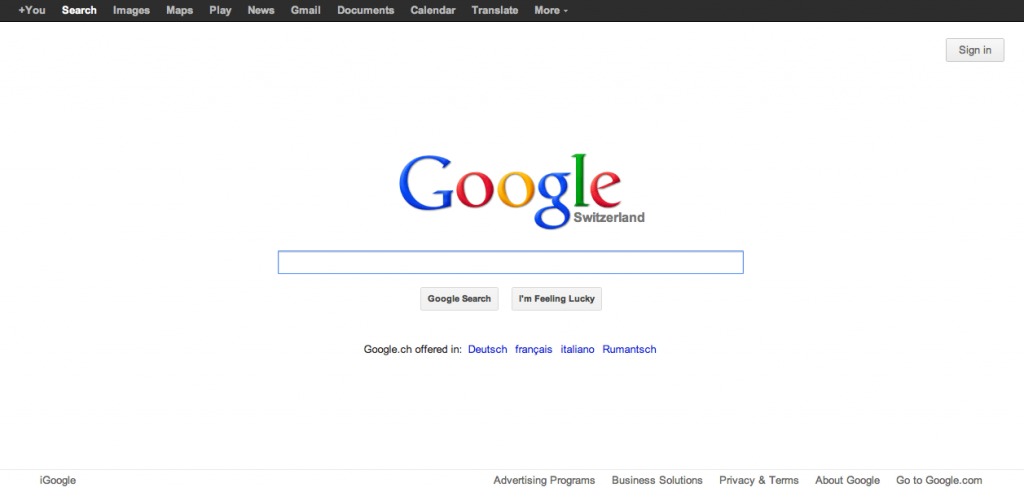
Google logos have evolved over time, but all of them have remained very simple and in a very similar style (you can see an example below). Some logos are designed by Google for particular events; they are called Google Doodles. Google Doodles can take many forms: images, games, puzzles. However, they are all designed in HTML5.
There are many Google logos created by amateurs; here is an example:
Additionally:
Google Doodles play an important role in strengthening brand recall and user engagement by celebrating global events, historical figures, and cultural milestones directly on the Google homepage.
Google Acquisitions and Strategic Company Growth
Platforms Acquired by Google
- November 2012: The search engine bought Incentive Targeting. It is a Groupon-like service.
- October 2012: Google acquires Viewdle, a facial recognition service.
- June 2012: Google acquires Quickoffice to improve Google Drive.
- June 2012: Google buys Meebo, an instant messaging service.
- May 2012: Google acquires Mike & Maaike.
- April 2012: TxVia, an electronic payment technology for the Google Wallet payment system.
- December 2011: Clever Sense is acquired by Google for Google Maps.
- November 2011: Kantago is acquired by Google for better management of circles in Google Plus, the social network of Google.
- September 2011: Zave Networks is acquired by Google for 1 billion dollars.
- August 2011: Google acquires Motorola Mobility to reinforce Android and manufacture hardware devices.
- Google acquires Pittpatt, a company specializing in facial recognition.
- Google acquires Dealmap in 2011. It is an aggregator of special offers at local shops.
- Google creates Google Plus, a social network.
- Google buys Ebook Technologies, a technology for reading books on the internet. This technology will be integrated into Honeycomb shelves and Google Books online.
- Phonetic Arts, a company specializing in speech recognition, will be included in many Google products.
- Widevine was bought by Google in 2010 for the optimization of video on the internet. This technology will be used on Google TV.
- Slide, a social gaming platform, was acquired by Google in 2010 for $182 million. It will promote the Android operating system.
- Social Deck, a company specializing in creating games on iPhone and Blackberry, was acquired for Android platform development.
- Zynga, which specializes in social games (Zynga Poker, etc.), was bought in 2010 for $182 million.
Instantiations, programming in Java. - Metaweb, a classification technology, was acquired by Google in 2010 for $100 million.
- ITA Software, which searches for flight plans for aircraft, was acquired in 2010 by Google for $700 million.
- Invite Media, a universal platform for ad buying and real-time optimization, was purchased in 2010 for $70 million.
- LabPixies, an Israeli company that creates widgets, was bought by Google in 2010 for $25 million.
- Agnilux, a data center designer and optimizer, was purchased in 2008 for $248 million.
- Episodic, a provider of online videos, was purchased in 2010 for an undisclosed sum.
- DocVerse, a collaborative tool for Microsoft Office, was bought by Google in 2010 to optimize Google Documents for $48 million.
- Picnik allows online photo editing and was purchased in 2010 for an undisclosed sum.
- Aardvark allows users to answer questions and was bought by Google in 2010 for $80 million.
- AppJet is a free online application service for Android and Chrome, acquired in 2009 for $58 million.
- Teracent, an online advertising platform, was bought by Google in 2009 with AdMob for $750 million.
- AdMob, an advertising platform, was bought by Google in 2009 for $750 million.
- Gizmo5, a voice analyzer, was purchased by Google in 2008 to improve Google Voice.
- Textcube, a 3D object editor, was created by Google in 2008.
- Omnisio allows video annotations and was bought for YouTube in 2008 for $15 million.
- ZAO Begun, a Russian contextual advertising platform, was bought in 2008 for $140 million.
- Jaiku, a Chinese platform, was bought in 2008 for an undisclosed sum and allows blog creation similar to WordPress.
- Zingku allows mobile users to exchange photos and business cards and was bought in 2007 for an estimated $250 million.
- Image America specializes in high-resolution cameras for Google Earth and was acquired in 2007.
- Postini archives emails and specializes in spam protection and was acquired in 2007.
- GrandCentral, a voice database, was acquired in 2007 to create Google Voice.
- Zenter was bought in 2007 to optimize Google Docs and Spreadsheets.
- FeedBurner, specializing in RSS feeds, was acquired in 2007 for $100 million.
- PeakStream, specializing in multiprocessor software, was bought in 2007 for $17 million.
- Panoramio, a photo-sharing site, was purchased in 2007 to optimize Picasa Web.
- GreenBorder, an antivirus publisher, was bought in 2007 and later used for Gmail and Blogger.
- Marratech, specializing in video conferencing, was purchased in 2007 for Gmail development.
- Tonic Systems, slideshow software, was bought in 2007 to compete with PowerPoint.
- DoubleClick, an online advertising platform, was bought by Google in April 2007 for $3.2 billion.
- Trendalyzer, an analytical chart platform, was acquired in 2007 and later used in Google Analytics.
- Adscape Media, a video game advertising platform, was acquired in 2007.
- Endoxon, a mapping company, was acquired in 2006 to develop Google Maps and Google Earth.
- YouTube, an online video hosting platform, was bought in 2006 for $1.65 billion.
In 2005, Google acquired the Android platform, becoming Google’s official operating system.
Here are all the Google services developed by these companies: Google News, Google Search, Google Calendar, Google Checkout, Google Labs, Google Notebook, Google Talk, Google Pack, Google Video, Google Images, Google AdSense, Google AdWords, Google Finance, Google Book Search, Google Translate, Google Maps, and Google Maps Sky.
Case Study 1: Google’s Acquisition of YouTube
Google’s acquisition of YouTube in 2006 for $1.65 billion transformed the company into a dominant force in online video. Despite early profitability challenges, YouTube became a key driver of advertising growth and global brand visibility.
Additionally:
Google’s acquisition strategy demonstrates a long-term vision focused on ecosystem expansion, technology leadership, and integration of innovative platforms into its core services.
Case Study 2: Google and the Android Platform
The acquisition of Android in 2005 allowed Google to enter the mobile operating system market. Android later became one of the most widely used mobile platforms in the world, supporting Google’s advertising, application, and service expansion.
Life at Google: Work Culture and Key Statistics
Life at Google
Google employs over 30,500 employees and processes more than 3,500 resumes a day using automated software. Most employees work at the Googleplex, a building partly powered by solar energy through more than 9,000 m² of solar panels.
Some Numbers
- Google receives 7.2 billion page views per day (45,000 requests per second).
- Monthly searches reach 90.8 billion.
- YouTube has more than 1 billion videos viewed per day.
- Over 91% of French people use Google, compared to 60% of Americans.
- Google generated approximately $1 billion from mobile advertising.
- 1,200 employees became millionaires through stock options.
- The director of Google earns $1 per year but is a billionaire.
- Google manages more than 150 official blogs.
Conclusion
Google’s continuous innovation, strategic acquisitions, and strong advertising model have positioned it as one of the most influential technology companies in the world, shaping how people search, communicate, and consume digital information globally.
IIFRA is a leading skill-development institute in India, specializing in Digital Marketing, Cyber Security, Ethical Hacking, Business Analytics, and other future-ready programs. With a strong focus on practical training, industry-aligned curriculum, and career-oriented learning, IIFRA empowers students and professionals to build successful careers in the digital and technology-driven world.